Back to News & Stories
CROI 2026 Prevention Round-up

The annual Conference on Retroviruses and Opportunistic Infections (CROI) took place 22- 25 February 2026, in Denver, Colorado against a backdrop of funding cuts, dismantled programs, and growing political interference. Despite this, there were some hopeful messages as recent PrEP research underscored the durability of new PrEP options and the importance of strong delivery systems to support their impact. Read on below for some of the key prevention highlights from CROI 2026.
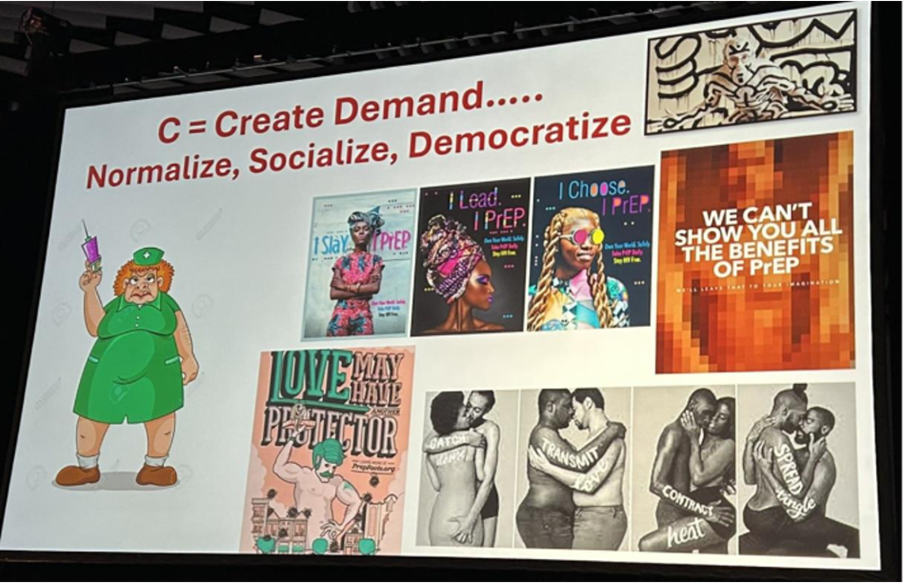
Photo from Linda-Gail Bekker’s opening plenary: “The ART of Prevention: People, Science, Progress.”
PrEP is highly effective but not reaching everyone who needs it
- Long-term follow-up of the ANRS PREVENIR study, presented by the study’s Principal Investigator, Jean Michel Molina, assessed 3,209 PrEP users in France across more than 13,000 person-years. Results showed HIV incidence of 0.11 per 100 person-years, with no significant differences between daily, on-demand, or switching regimens, reinforcing PrEP’s real-world effectiveness.
- Andrew Hill highlighted the stark gap between PrEP need and access and suggested that more than 40 people must be reached with PrEP to prevent a single HIV acquisition – but that only 122 countries reached this 40:1 target. Only 2.3 million people are currently on oral PrEP, far below UNAIDS targets, and injectable cabotegravir and lenacapavir represent just 2.9% and 0.9% of use, respectively.
Lenacapavir- development, new resistance data, and efficacy trials for a 12 month version
- Wes Sundquist of the University of Utah described the HIV capsid and its importance in the development of LEN. His research collaborations, which began in the early 1990’s, led to understanding the structure, functions, and inhibition of the HIV capsid. As he shared with AVAC on a June webinar, “LEN didn’t emerge overnight. It’s the result of patient, persistent basic science—of believing we could understand a virus deeply enough to target it effectively.” He closed by reflecting on the “bench to bedside to community” journey that made LEN possible, crediting clinicians, regulators, and community activists, and warned that while the field now has “a really powerful new tool in the arsenal,” forces are blocking its use. “It will be a human tragedy,” he said, “if we don’t overcome those.”
- Resistance data from the PURPOSE 1 and PURPOSE 2 lenacapavir for PrEP (LEN) trials were presented by Stephanie Cox of Gilead, which showed that across both studies, resistance was rare and occurred in the context of waning drug levels of monotherapy. Of two HIV acquisitions occurring among participants taking LEN in PURPOSE 1, one was diagnosed at Study Day 365 with the capsid resistance–associated substitution N74D, while the other acquired HIV at Study Day 670, more than a year after their final LEN dose and with no resistance observed. In PURPOSE 2, two previously reported participants developed the N74D capsid substitution, while one newly identified case developed Q67H+K70R. The five total infections across the two trials highlight that while not perfect protection, LEN is clearly a remarkably safe and effective prevention option.
- Gilead presented trial design and dose modeling for a new study testing once-yearly lenacapavir for PrEP. PURPOSE 365 is a single-arm, open-label study that will enroll 300 people who would benefit from PrEP. Based on population pharmacokinetic (PK) modeling, a dose of 3000 mg delivered intramuscularly was chosen, including 600 mg of oral loading doses on Days 1 and 2.
MK-8527- dose selection for efficacy trials
- Data on dose selection for the investigational monthly oral PrEP candidate MK-8527 showed that a once-monthly 11 mg dose could maintain protective drug levels in at least 95% of participants, including pregnant people and adolescents, while allowing an additional week of coverage for late doses. The cumulative data from Phase I and II studies informed the dose selection in the newly launched Phase III EXPrESSIVE efficacy studies.
Cabotegravir- supporting choice and continuation
- Gabriel Chamie presented data from the SEARCH study, a community health intervention pairing digital tools with tailored in-home HIV services provided by trained community health workers that reduced HIV incidence by 70%. The findings underscore the power of bridging communities and health systems through technology and locally driven care.
- In a Malawi study presented by Deborah Hoege, people initiating long-acting injectable cabotegravir had higher continuation rates than those on oral PrEP (61% vs. 21% at month 1; 41% vs. 7% at month 5).